
How to Get More Instagram Followers for a T-Shirt Store
Most advice about growing an Instagram account for a t-shirt business is four years out of date. Load up on hashtags. Post every day at 8 am.
Connect your account to Facebook. Instagram has changed how it decides who sees your posts, and a fair bit of that advice no longer works.
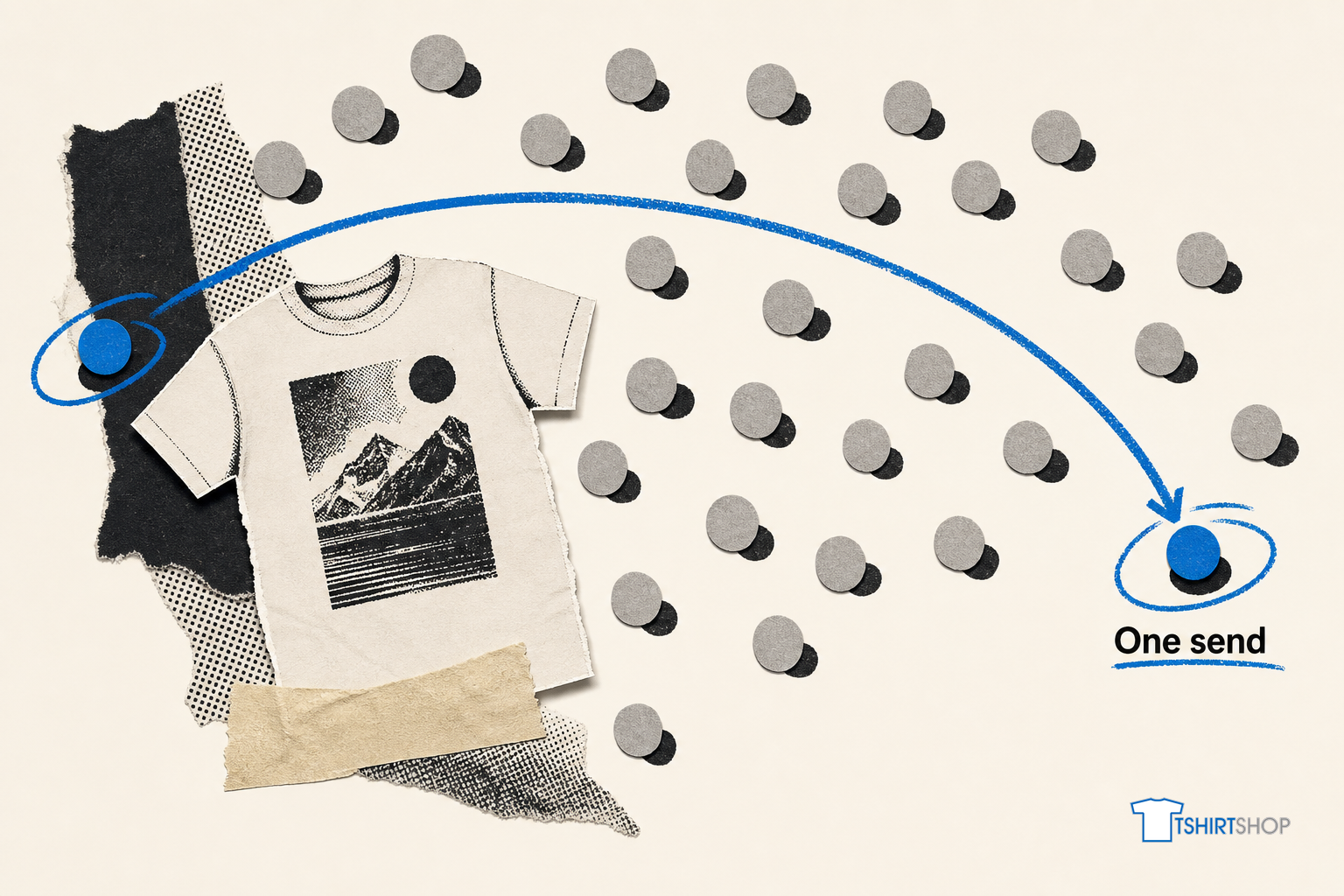
Collage of a t-shirt among inert viewers, with one blue arc connecting a single sender to one recipient
There’s also a bigger problem with the question. You don’t need followers. You need people who buy shirts. Those are different groups, and mixing them up is why plenty of t-shirt accounts sit on 4,000 followers and two sales a month.
The thing Instagram rewards most in 2026 happens to be the same thing that sells a niche tee. So you don’t have to pick between growing the account and growing the business.
The one number that actually grows a t-shirt account
Instagram splits your reach in two. Connected reach is people who already follow you. Unconnected reach is everyone else, and that’s where growth comes from.
Before you get any of the second kind, your post has to pass an audition. Instagram shows it to a small group of people who don’t follow you and watches what they do. If they keep watching, save it, or send it on, the post goes to a bigger group, then a bigger one. If they scroll straight past, it stops there, sometimes before most of your own followers have seen it.
The strongest signal in that audition is the send. Not the like. The send, meaning someone taps the paper plane and fires your post into a DM.
A like says “that’s nice.” A send says “this is so you.” Only one of those ends with a shirt in a cart.
If you sell niche tees, that’s a gift. Your product is already the most sendable thing on the platform. Nobody DMs their mate a photo of a plain white tee. They absolutely DM their mate a shirt that says “May The Forks Be With You” if that mate rides. You don’t have to bolt the send onto your content as some kind of tactic. It’s what your content already is, if you let it be.
Which turns the question from “how do I get more followers” into something more useful. What would make someone send this to one particular person they know?
Fix your bio so it works as a search result
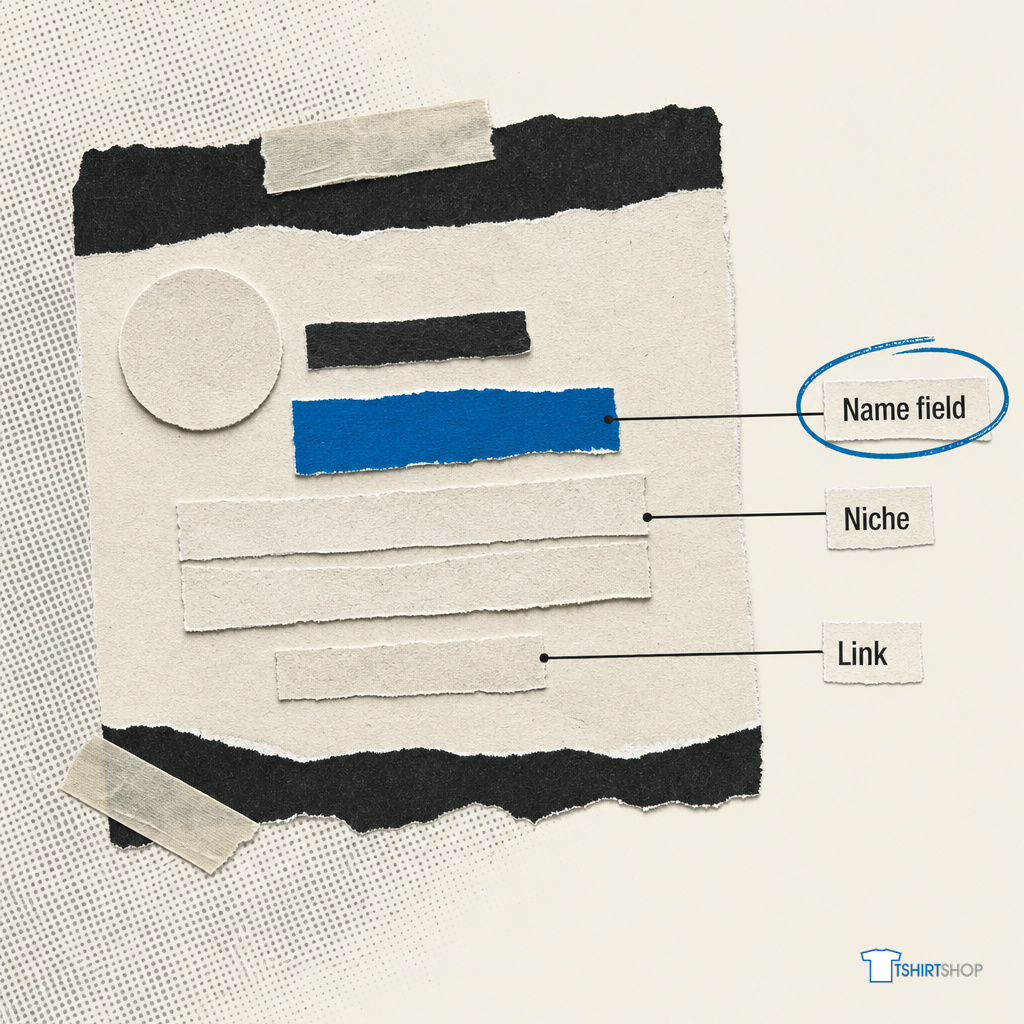
Paper collage of an Instagram profile with the name field, bio and link strips called out
Your bio isn’t an about-me. It’s a search result and a decision, and you get roughly two seconds for both.
Two things changed here. Instagram now weighs the actual words in your name field and bio when someone searches. And since mid-2025, Google indexes public content from professional Instagram accounts by default, profiles and captions included. Your Instagram presence is findable from outside Instagram now.
So the name field, the one sitting under your handle, isn’t for your business name a second time. It’s a keyword field. “Nathan’s Tees” tells Instagram nothing. “Motorcycle & 4×4 T-Shirts | Australia” tells it exactly who to show you to.
The rest of the bio has three jobs. Say the niche out loud, and not as “quality apparel” either. Say motorcycle, or cycling, or gamer, or beer, or whatever it actually is, because vague is invisible. Kill the delivery objection while you’re there: “printed and shipped from Australia” answers the question every Australian buyer is quietly asking, which is whether the thing turns up before the event they need it for.
Then point your link somewhere specific. Someone who arrived from a 4×4 reel should land on 4×4 shirts, not your homepage.
Write captions for search, not for hashtags
Hashtags used to be the discovery engine. They aren’t anymore. Following a hashtag was removed at the end of 2024, and the limit dropped from thirty per post to five. Mosseri has said plainly that hashtags don’t directly drive reach. What they do now is filing: they tell Instagram what your post is about.
Use up to five, pick accurate over popular, then stop thinking about them.
The discovery work has moved into the caption. Instagram reads your caption, your alt text, and text shown in the video itself, and uses all of it to match your post against what people search for. Write the words a buyer would actually type.
“New drop link in bio” gives Instagram nothing to work with. “Funny motorcycle t-shirt for anyone who spends more on the bike than the rego. Printed in Australia, sizes S to 5XL” hands it a whole category to file you under, and it still sounds like a person wrote it.
Get your plainest keyword into the first line while it still reads naturally. If it sounds stuffed in there, take it out. Instagram isn’t fooled, and neither is the reader.
Test the design before you print it
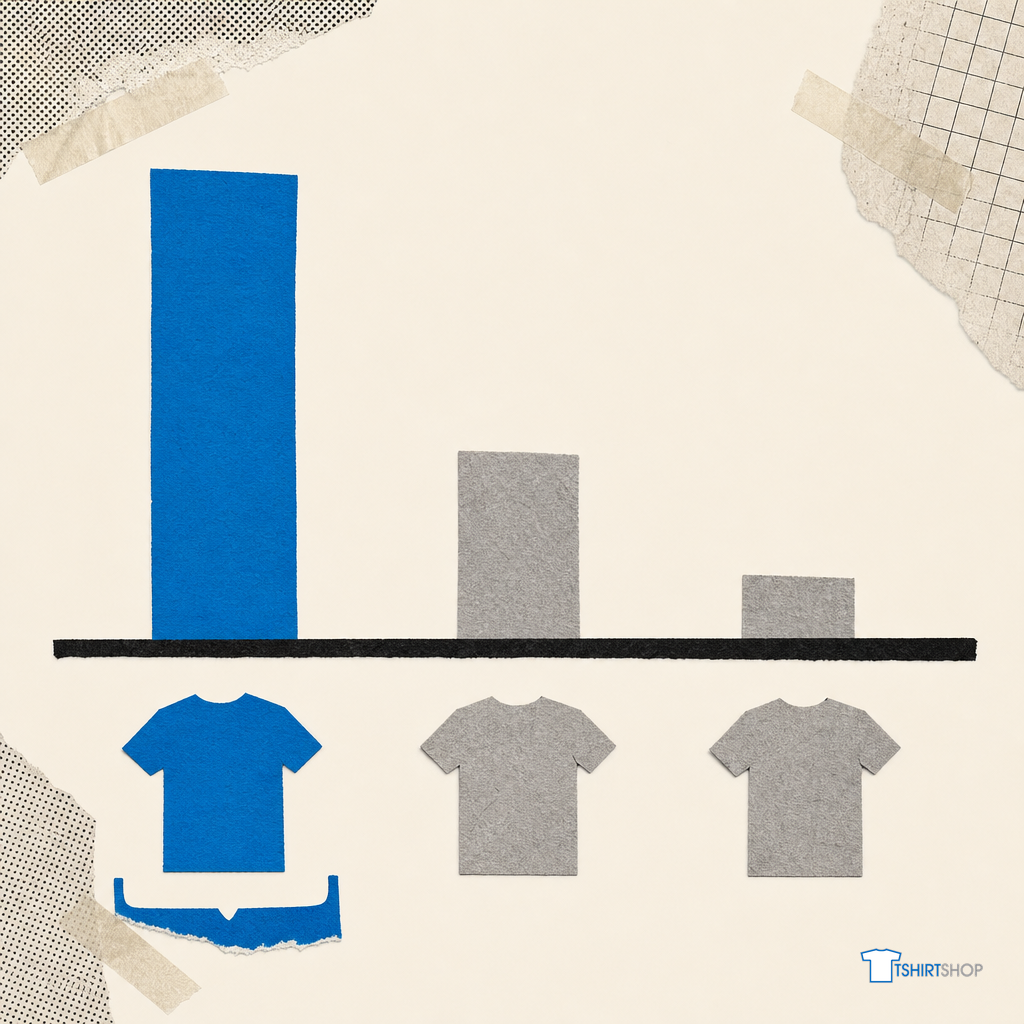
Three t-shirt designs with send-count bars above them, the tallest bracketed as the one to print.
For a print business, this one is worth more than everything above it, and almost nobody writing about Instagram for t-shirt sellers brings it up.
Instagram has a feature called Trial Reels. A trial reel goes only to people who don’t follow you. It stays off your grid, out of your followers’ feeds, and out of your Reels tab. You get performance data back within about 24 hours, and if it does well, you can push it to everyone, or set it to do that on its own after 72 hours.
That’s a free focus group of strangers, in private, reporting back in a day.
So point it at the artwork, not just the marketing. Mock up three designs you’re considering. Post each as a trial reel. The one that gets sent and saved is the one you print. The two that flatline cost you nothing, and nobody who follows you ever knew they existed.
It beats asking your followers, who like you and will be nice about it.
Shoot the shirt like someone’s going to wear it
“Post high quality content” means nothing until you say what quality is for your product. For a t-shirt account, it comes down to three fairly concrete things.
The design has to be legible at thumbnail size. Most people meet your shirt as a small square while scrolling, and if the joke needs squinting, the joke doesn’t land. The post dies in the audition.
Put it on a person, in the situation it gets worn in. A flat lay on white is a product photo. Fine on the product page, dead on Instagram. The 4×4 shirt goes on someone standing next to a 4×4. The Halloween shirt goes to a party. People are buying the moment, and the shirt is how they get into it.
And show the print. A close shot of real ink on real fabric does a job no amount of copy does. If you’re printing DTG here in Australia, two seconds of the printer running beats a paragraph claiming quality.
Original also beats reposted, and not just as a matter of principle. Instagram gives original content significantly more distribution, and accounts leaning on reposts, somewhere around ten or more in a month, can drop out of recommendations altogether. If the plan is to repost other people’s designs, there isn’t a plan.
Post less often than you think
The old advice was at least once a day. Don’t. It’s the fastest way to burn out and to teach Instagram that your account produces mediocre posts.
Every post gets judged on its own now. Three strong posts a week beat seven weak ones, because the weak ones don’t get carried along by the strong ones. They just fail quietly.
Timing works the same way. The old rule was 8 to 9 am and 5 to 6 pm, and it was always shakier than it sounded. Australia runs across three time zones, so a single national posting time was never real to begin with.
What decides your post’s fate is how that audition group behaves in the first few minutes, not where the clock was when you hit share. Post when you’ve got something good.
If you want a real answer on timing, your own Insights tab knows when your audience is awake. That number beats any number in any blog post, this one included.
Show up in the niche, not in the comments of big accounts
The old version of this was liking and commenting on random photos hoping for a follow back. You’ll lose that numbers game, and the follows you do win don’t buy shirts.
The version that works is narrower. Find where your niche actually talks. Motorcycle accounts, cycling clubs, 4×4 groups, gaming pages, local event pages. Turn up there as the brand, with something to say.
This works for niche tees in a way it never works for general apparel, because these communities have a sharp sense of who’s one of them. A shirt that proves you get the joke is an identity marker. You can’t fake your way in, but if you genuinely sell to the niche then you’re already there.
Local events help here too. Rides, meets and club days are searchable, and a location tag on content you actually shot at one will put you in front of people nearby. Tagging your suburb on a studio photo won’t. The tag earns its keep when the location is part of the post and does very little when it’s decoration.
Use Stories for proof and questions
Stories won’t grow your account much. They convert the audience you’ve already got, which is a different job and just as useful.
Proof is the first half. The printer running, shirts getting packed, parcels going out, the sizing chart, a photo a customer sent in. Every one of those answers something a hesitant buyer is already wondering about. Will it arrive on time? Will the print be any good? What size am I?
Questions are the second half. Poll and question stickers are the lowest-friction ask on the platform. “Which of these two do we print?” gets answers, tells you something real, and hands people a small stake in whichever design wins.
What to do when a post flops
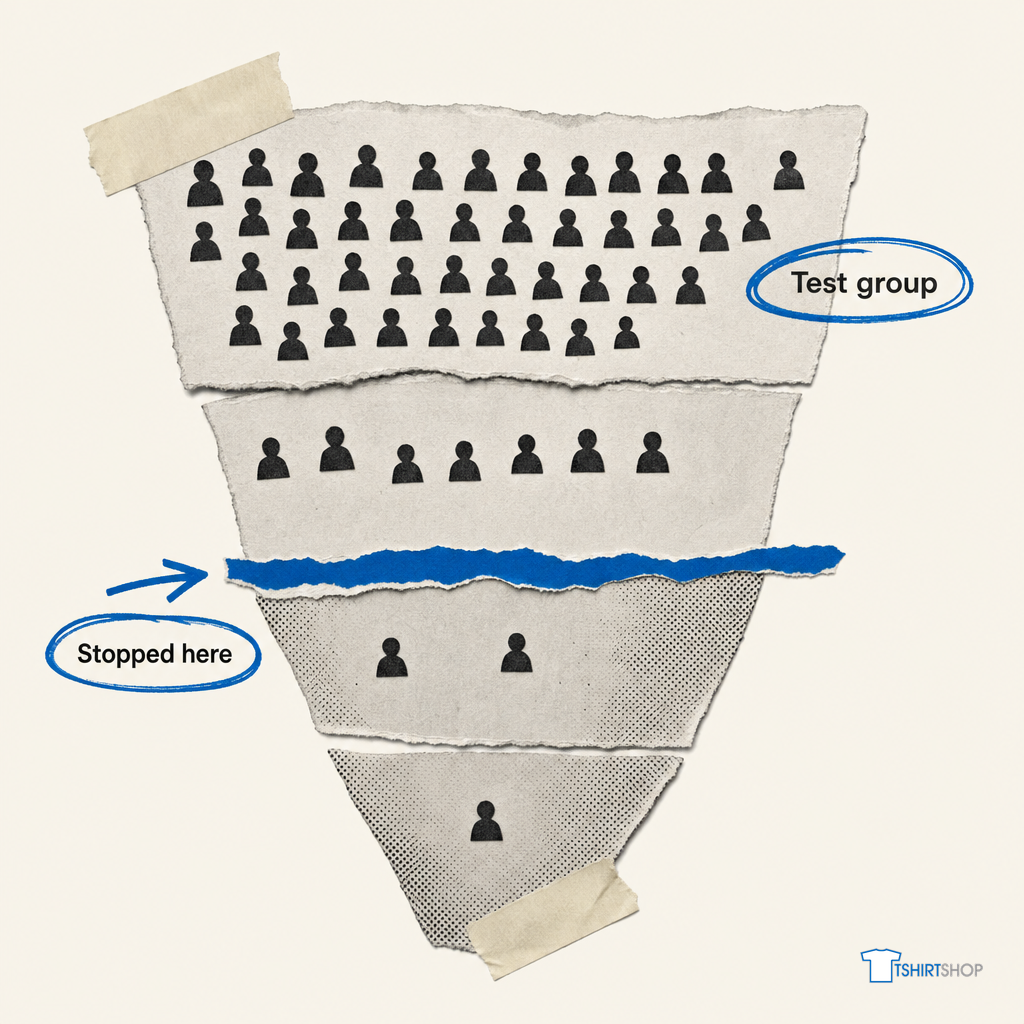
Funnel of paper bands narrowing sharply, with a blue tear marking where a post stopped spreading
It’ll happen, and every new account’s first instinct is that they’ve been shadowbanned. Almost always, they haven’t.
What actually happened is the audition. The post went out to a small test group of non-followers, they scrolled past, and it stopped there. That isn’t a punishment. That’s the system doing exactly what it’s built to do with a post that didn’t hold attention.
Have a look at where it lost people. Watch time collapsing in the first second means the opening frame was the problem. Plenty of watching but no sends or saves means the shirt didn’t connect to anyone they know. Saves but no clicks means the way to buy it wasn’t obvious.
One flop is noise. Four in a row on the same format is telling you something about the format.
Cross-posting to Facebook is housekeeping, not growth
The old tip said linking Instagram to Facebook lets your Facebook friends see your posts and grows your audience. Connecting them is worth doing, since it makes cross-posting and running a shop across both platforms less painful.
It won’t grow your Instagram audience though, and treating it as a growth tactic is how accounts end up with identical dead content in two places.
Connect it, use it for the plumbing, get back to making things worth sending.
Watch your competitors properly
The original version of this advice was to pay for a tool. You don’t need one.
Open a competitor’s profile, go to their Reels tab, sort by view count. What you’re after isn’t their average post. It’s the gap between their median and their top few outliers, because those outliers show you which designs, formats, and jokes travelled past their own followers.
Then ask the honest question. What made someone want to send that? Copy the mechanism. Never copy the design, which in a marketplace business is how you get delisted, and in a niche where everyone knows everyone, it’s a bad look on top.
The short version
- Stop counting followers. Count sends and saves.
- Make things one person wants to fire into a DM for one specific mate.
- Write captions in the words a buyer would search. Five hashtags, maximum.
- Put the niche and “ships from Australia” in your bio and name field.
- Test designs with Trial Reels before you commit them to print.
- Fewer, better, original. Three good posts beat seven filler ones.
- Show up where your niche already talks.
- Stories are for proof and questions.
If you’re making designs and want somewhere to sell them without building a store from scratch, The T-Shirt Shop runs a designer marketplace. Your designs get listed, we handle the printing here in Australia and the shipping, and you carry on doing the part you’re good at.
You can register as a designer here, have a look at the designers already selling through us, or start with the t-shirt designer tool if you’re still working on an idea.
Worth reading next: how to build a following using social media, the best strategies for growing an online following, and how to become a t-shirt designer.
Related Posts



Resources For T-Shirt Designers
- Design a t-shirt online as a sample
- Bulk T-Shirt Printing Company
- Get Rough Sketches Redrawn Professionally
- Free T-Shirt Store – Free listing – earn commission
- Drop Shipping T-Shirts – Connect your store
- Build a Website for Selling T-Shirts On
- Buy a Ready-made Drop Shipping Website
- Get help Marketing and Advertising your product
- Learn about T-Shirt Printing Machines